

Mexico Customs Valuation Declaration Documents | TradeWorks
Many importers treat the Customs Valuation Declaration (known in Mexico as the Manifestación de Valor, or MV) as just another form to fill out and upload to the government portal. The real problem comes later: when Mexico’s tax authority (SAT) audits the operation and requests the supporting documents that should have accompanied it.
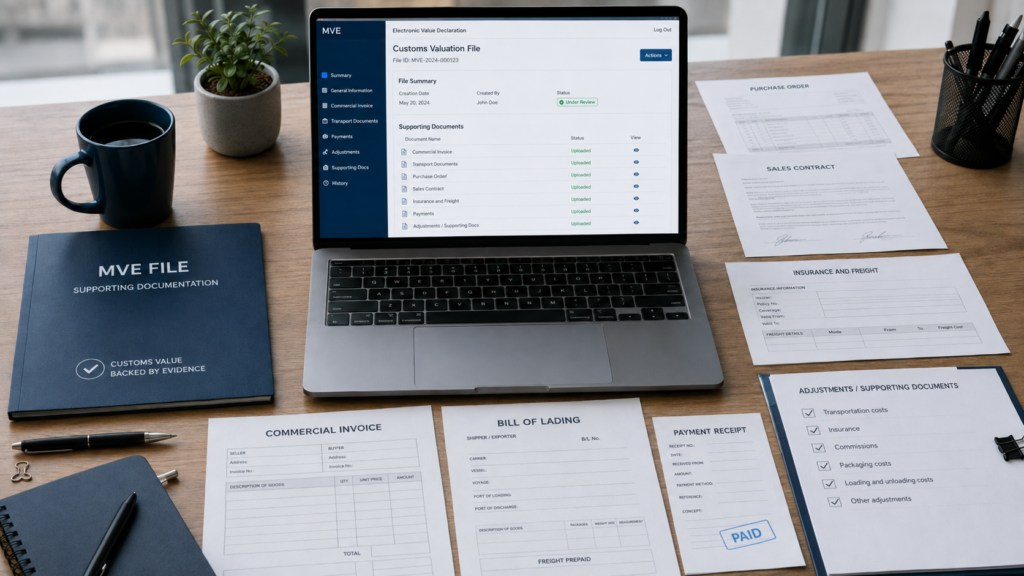
Article 81 of the Customs Law Regulations (RLA) is specific about what those documents are. Here is what it requires, item by item.
What is the legal basis for this obligation?
Article 59, Section III of Mexico’s Customs Law (Ley Aduanera) requires importers to provide all information necessary to determine the customs value of their goods.
Article 81 of the RLA builds on that obligation by listing the specific documents that must be attached to the MV. This is not a best-practice checklist — it is a legal requirement.
Article 220 of the RLA further requires the Customs Broker (Agente Aduanal) to retain all of those documents. Failure to do so constitutes a separate violation.
What documents does Article 81 RLA require?
| Item | Document | What it must include and when it applies |
|---|---|---|
| I | Commercial invoice or equivalent document | The foreign supplier's commercial invoice, meeting the requirements established under Mexico's General Foreign Trade Rules (RGCE 3.1.8). Without this document there is no basis for the declared customs value. |
| II | Transport document | Bill of lading (BL), airway bill (AWB), packing list, or equivalent depending on the mode of transport. Legal basis: Article 36-A, Section I, subsection b of Mexico's Customs Law. |
| III | Certificate of origin and provenance | Required whenever origin is relevant to the operation: applying preferential tariff treatment under a trade agreement, contesting countervailing duties, safeguard measures, or non-tariff restrictions. Legal basis: Article 36-A, Section I, subsection d of the Customs Law. |
| IV | Guarantee document | The document evidencing the guarantee referenced in Article 36-A, Section I, subsection e of the Customs Law. Applies primarily when the authority questions the declared value and requires a guarantee as a condition for releasing the goods. |
| V | Proof of payment | Wire transfer confirmation, letter of credit, or any evidence of actual payment for the goods. This document is critical to demonstrate that the declared value reflects the price actually paid. |
| VI | Freight, insurance, and related costs | Documentation supporting each cost component included in the customs value calculation, consistent with the Incoterm agreed upon for the transaction. |
| VII | Contract and, where applicable, purchase orders | The contract is the primary document. If your commercial relationship should generate a formal contract and you do not have one, this is not a minor gap — it is a direct non-compliance with this provision. A purchase order (PO) does not replace the contract; it complements it. |
| VIII | Dutiable additions to value | Documents supporting any amounts added to the transaction value under Article 65 of the Customs Law: commissions, royalties, license fees, technical assistance, special packaging, and similar charges. |
| IX | Additional documentation | Any other information or documentation needed to determine the customs or commercial value of the goods. This provision does not make any of the above documents optional — it gives the authority the right to request documentation beyond the base list. |
| X | Credit notes and discounts | Documents evidencing any discounts — in cash or in kind — applicable to each purchase transaction, whether paid in installments or in full. |
What happens if a document is missing during an audit?
SAT can request the MV and all its supporting documents for any operation going back up to five years (Article 67 of the Federal Tax Code and Article 221 of the RLA).
If a document is missing, the authority has grounds to reject the declared transaction value (Article 72 of the Customs Law) and determine customs value using alternative methods — which are typically higher. This translates into back taxes, surcharges, penalties, and potentially a formal customs administrative proceeding (PAMA).
This is not a theoretical risk. It is one of the most common outcomes in the electronic reviews and audits that SAT has intensified since the MV became mandatory through the VUCEM government portal as of April 1, 2026.
How do you know if your MV file is complete?
The starting point is reviewing each import operation against the Article 81 RLA checklist, item by item.
At TradeWorks, we walk through that review with you: we identify what you have, what is missing, and how to build a document file that can withstand any authority review.
To understand how the Customs Valuation Declaration works within Mexico’s VUCEM portal and what correct filing actually involves, read: Customs Valuation Declaration in VUCEM.